
By Christopher Sunday

My engagement with QS Aminu Abubakar Suleiman, FNIQS, has given me an opportunity to observe his approach to public service, his conversations about the future of Kogi East, and his understanding of the relationship between leadership and the aspirations of the people. One thing that has particularly drawn my attention is the importance he places on connecting political ambition with a development agenda. For me, the most significant question in any electoral contest is not merely who wants to occupy an office, but who is prepared to explain what that office should accomplish, how its responsibilities should be discharged, and how the people can hold its occupant accountable. This is why his manifesto, The People’s Mandate, deserves serious public attention.
In a political environment where election campaigns are often dominated by slogans, declarations of loyalty, personality contests and promises of immediate benefits, the presentation of a manifesto creates an opportunity to move the conversation to a more substantive level. It invites citizens to examine ideas, question proposals and assess the priorities an aspirant intends to pursue. To my knowledge, the public presentation of a comprehensive manifesto by a Kogi East senatorial candidate is an uncommon development in the political history of the district. That observation makes the emergence of The People’s Mandate particularly significant, while also placing a responsibility on the candidate to ensure that its promises remain open to public scrutiny.
The question, therefore, is not simply whether QS Aminu has a manifesto. The more important question is what the manifesto contains, how it responds to the realities of the Igala and Bassa people, and whether its proposals reflect a serious understanding of the responsibilities of a senator in Nigeria’s constitutional democracy.
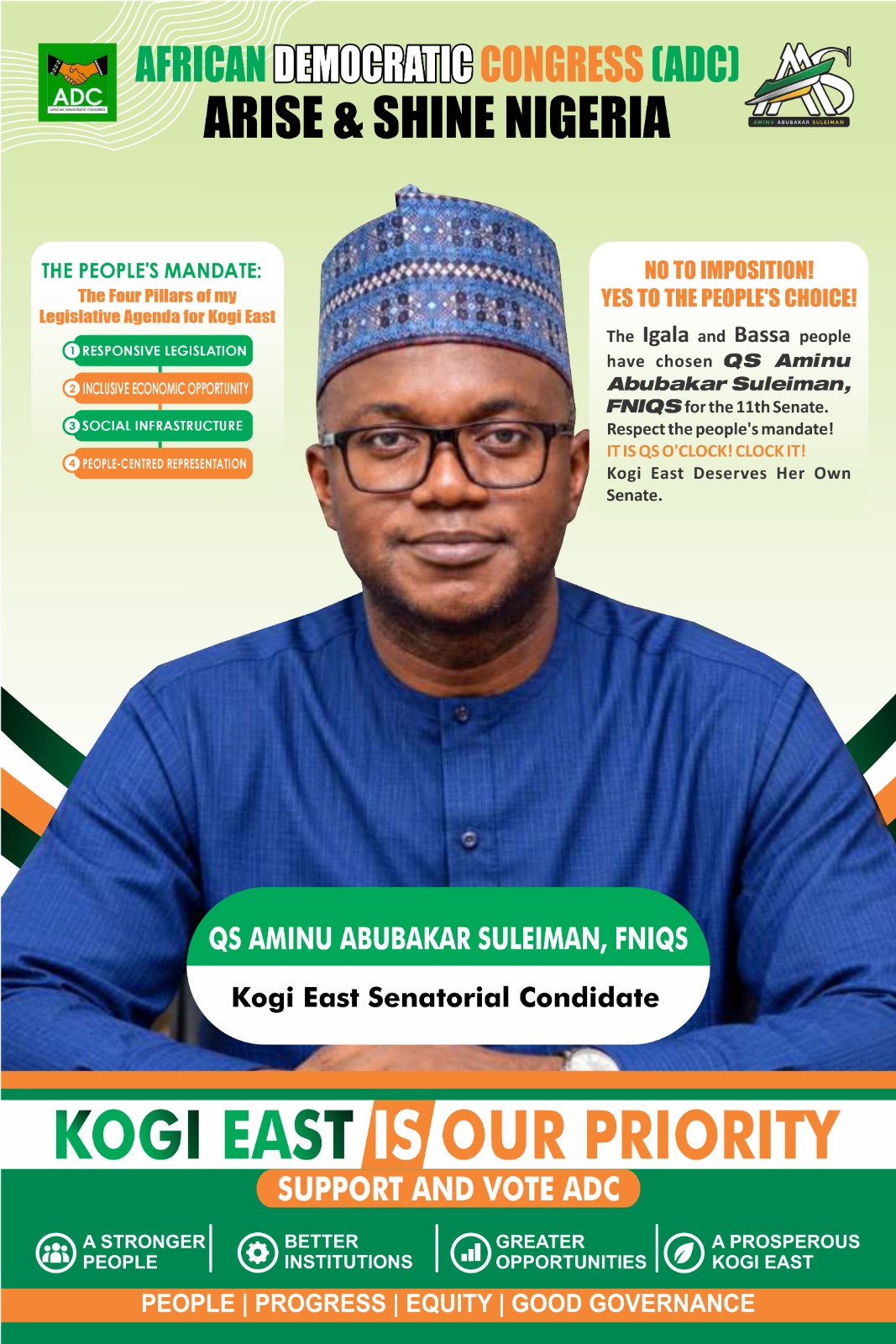
A manifesto should be more than a campaign document designed to generate excitement during an election season. It should communicate a clear vision, identify the challenges confronting the people, establish priorities and provide a framework against which public commitments can be evaluated. This is the context in which I consider The People’s Mandate, built around four principal pillars: Responsive Legislation, Inclusive Economic Opportunity, Social Infrastructure, and People Centred Representation.
These four pillars provide a framework for discussing what representation in the 11th Senate should mean for Kogi East. They also create an opportunity to shift public debate from personalities alone to the substance of governance.
Responsive Legislation recognises the central responsibility of the National Assembly. Senators make laws, participate in budgetary processes, exercise oversight over public institutions and advocate policies that affect the lives of citizens. For Kogi East, responsive legislation should mean paying attention to the realities of rural communities, the challenges facing farmers and traders, the needs of young people, the quality of healthcare and education, and the institutional reforms necessary to improve public welfare.
A senator cannot independently execute every project in a constituency, nor can legislative representation replace the responsibilities of state and local governments. However, a committed representative can use legislative influence, budget scrutiny, oversight, policy engagement and collaboration with relevant federal institutions to advance legitimate community interests. This distinction is important because the people deserve an honest understanding of what their representative can do, what requires cooperation with other institutions, and what should be monitored through sustained public engagement.
For me, the value of any legislative agenda lies in its ability to connect public policy with human experience. A law is not merely a collection of words passed in the National Assembly. At its best, it establishes standards, protects rights, improves institutions and creates conditions for citizens to live with dignity.
Consider healthcare. Families in rural communities should not have to endure avoidable hardship because essential services are inaccessible. A legislative agenda that takes healthcare seriously should explore practical ways to strengthen primary healthcare, improve access to essential services, encourage appropriate federal interventions and promote effective oversight of public health programmes.
The same reasoning applies to education. Young people need institutions that prepare them for employment, enterprise and responsible citizenship. Legislative engagement can support policies that improve educational access, strengthen vocational training and expand opportunities for skills development.
Agriculture also deserves attention. In communities where farming sustains families and supports local commerce, rural connectivity, storage facilities, market access and agricultural financing are important development concerns. These are areas where effective representation can help draw attention to neglected needs and promote coordinated responses.
The test of Responsive Legislation, therefore, is whether the manifesto’s ideas can be translated into clearly defined legislative priorities, credible advocacy and measurable public outcomes.
The second pillar, Inclusive Economic Opportunity, addresses a fundamental question: who benefits from development? Economic opportunity should not be concentrated among a few individuals or confined to those with access to political influence. Young people, women, artisans, persons with disabilities, small business owners and micro, small and medium enterprises should all be considered in the design of policies intended to expand prosperity.
Kogi East has people with ideas, skills, businesses and productive capacities. What many need is an environment that allows their efforts to yield better results. Access to finance, relevant training, markets, infrastructure and business support can help people turn their abilities into sustainable livelihoods.
A senator’s contribution to this process may involve legislative reforms, budgetary advocacy, oversight of relevant agencies and engagement with public and private institutions. Such interventions require careful coordination, realistic expectations and transparent procedures. The importance of this pillar lies in its insistence that development should be inclusive. It encourages a conversation about how opportunities can be widened rather than distributed solely through political patronage.
For QS Aminu, the challenge is to demonstrate how the principles of Inclusive Economic Opportunity would inform his legislative priorities and how citizens would be able to monitor the commitments made under this pillar.
The third pillar, Social Infrastructure, speaks to the facilities and systems that enable communities to function, businesses to grow and families to access essential services. Roads, healthcare facilities, schools, water supply and other basic infrastructure are not luxuries. They shape the daily experiences of citizens and influence the economic prospects of entire communities.
In Kogi East, infrastructure priorities should be identified through engagement with communities and an honest assessment of their needs. Rural roads can improve access to farms and markets. Better healthcare facilities can reduce the burden of travelling long distances for essential services. Reliable water supply can improve public health and household welfare. Educational infrastructure can create better conditions for teaching and learning.
However, responsible representation requires clarity about institutional responsibilities. A senator does not possess unilateral authority to construct every road, establish every hospital or execute every federal project. The legislative role involves advocating for appropriate budgetary provisions, engaging relevant agencies, scrutinising implementation and helping communities navigate the processes through which federal interventions are pursued.
This is why a manifesto becomes useful when its broad aspirations are supported by clear priorities, implementation channels and accountability mechanisms. Social infrastructure should not be discussed merely as a catalogue of projects. It should be understood as an investment in human dignity, economic productivity and the long term development of Kogi East.
The fourth pillar, People Centred Representation, brings the other three pillars into perspective. Representation loses its meaning when citizens become relevant only during campaigns. The relationship between representatives and their constituents should continue throughout the tenure of office, with opportunities for consultation, explanation and accountability.
The people of Kogi East should be able to communicate their concerns, understand their representative’s legislative activities and receive regular information about the progress of public commitments. Such representation requires more than physical presence at community gatherings. It requires listening, maintaining accessible channels of communication, consulting relevant stakeholders and explaining the decisions made in the people’s name.
It also requires honesty. Where a proposal encounters institutional, financial or constitutional limitations, citizens deserve an explanation. Where progress is achieved, they deserve to know what was done and how it was accomplished. Where commitments remain unfulfilled, there should be room for questions and accountability.
People Centred Representation should therefore be understood as a continuing relationship of public trust, not a campaign slogan. For a diverse senatorial district comprising Igala and Bassa communities, this principle also requires inclusion. Every community should have the opportunity to make its concerns known and expect fair consideration within a shared development agenda.
What interests me about The People’s Mandate is the opportunity it creates to examine the content of representation before the election rather than waiting until after the mandate has been given. If, as my experience suggests, publicly presenting a comprehensive manifesto has not been a common feature of senatorial contests in Kogi East, then this development deserves closer examination. It could help establish a stronger expectation that aspirants should explain their priorities, clarify the limits of their offices and submit their ideas to public scrutiny.
But the significance of a manifesto cannot rest on its mere existence. A document may contain admirable principles and still require further clarification about priorities, implementation, financing, institutional responsibilities and monitoring. The real value of The People’s Mandate will depend on the seriousness with which its four pillars are developed, communicated and pursued. Its promises must be sufficiently clear for citizens to understand them and sufficiently practical for progress to be assessed.
This is the distinction between a manifesto as a campaign publication and a manifesto as a public accountability framework. The former communicates ambition. The latter creates expectations that can be examined throughout the political process.
The political future of Kogi East should not be reduced to personality contests, ethnic suspicion or the temporary excitement that accompanies election campaigns. The Igala and Bassa people have shared interests in education, healthcare, agriculture, infrastructure, employment, enterprise and the responsible management of public resources. These interests should encourage constructive political debate and a willingness to examine competing ideas on their merits.
No manifesto should be exempt from scrutiny simply because its author has presented it publicly. Equally, the effort to articulate a development agenda should be assessed on its substance rather than dismissed without examination. Citizens should ask questions, request clarification and examine the relationship between proposed commitments and the constitutional responsibilities of the Senate. Political participation becomes more meaningful when people have access to information and can engage candidates on issues that affect their lives.
For QS Aminu, The People’s Mandate provides a basis for this engagement. For the people, it provides an opportunity to ask what the four pillars mean in practical terms and how the proposed approach would respond to the specific needs of their communities. That is the kind of conversation a serious electoral contest should encourage.
The phrase a sound mind in the title of this article is not a medical judgment or a claim that any political aspirant possesses a monopoly on wisdom. It is a call for sound reasoning, informed decision making and a serious approach to the responsibilities of public office. The Senate requires representatives who understand legislation, respect constitutional processes, engage policy questions carefully and appreciate the difference between promises and achievable commitments. It also requires citizens who are prepared to look beyond campaign rhetoric and examine what candidates propose to do with the authority they seek.
My personal engagement with QS Aminu has informed my interest in his approach to public service. Yet the broader question of representation must ultimately be addressed through evidence, the content of his manifesto, the credibility of his commitments and the public’s assessment of his proposals.
That is why The People’s Mandate deserves attention. Its four pillars create a framework through which the conversation about Kogi East’s future can become more specific, more informed and more accountable. The next step is to ensure that every pillar is explained in practical terms, with clearly stated priorities and realistic pathways for legislative action.
The contest for representation in the 11th Senate offers Kogi East an opportunity to deepen its political conversation and strengthen public expectations of those seeking the people’s trust. QS Aminu Abubakar Suleiman’s The People’s Mandate places four themes at the centre of that conversation: Responsive Legislation, Inclusive Economic Opportunity, Social Infrastructure and People Centred Representation.
These themes speak to important questions about how laws should respond to citizens, how economic opportunities can be widened, how infrastructure needs can be pursued and how representatives should remain accountable to their constituents. The importance of presenting a manifesto lies in making such questions discussable before an election. Its ultimate value lies in whether the people can examine its proposals, understand its commitments and measure progress against them.
For the Igala and Bassa communities, the task is to insist on a political culture in which ideas matter, public promises invite scrutiny and representation is treated as a responsibility rather than a privilege.
The future of Kogi East deserves that seriousness. The people deserve that conversation. And every aspirant seeking their mandate should be prepared to explain how their vision would serve the public interest.
A manifesto should not end the conversation. It should begin a more informed one.